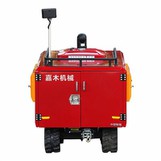
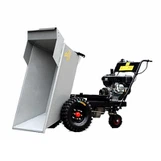
In the realm of emergency rescue operations, the role of Rescue Crawlers has become increasingly significant. As a dedicated Rescue Crawler [/special-outdoor-equipment/intelligent-rescue-crawler/rescue-crawler.html] supplier, I've witnessed firsthand the transformative impact these devices have on saving lives and minimizing damage in various disaster scenarios. One of the most critical aspects of their effectiveness lies in the seamless coordination between multiple Rescue Crawlers. In this blog, I'll delve into the mechanisms and strategies that enable this coordination, shedding light on the technology and teamwork behind it.
Understanding the Need for Coordination
Before we explore how coordination is achieved, it's essential to understand why it's so crucial. In large - scale disaster areas, such as collapsed buildings, wildfire - affected regions, or earthquake - stricken zones, a single Rescue Crawler has its limitations. The area to be searched can be vast, and there may be multiple hazards and obstacles. By deploying multiple Rescue Crawlers, we can cover more ground in less time, increasing the chances of finding survivors and assessing the situation accurately.
Moreover, different Rescue Crawlers can be equipped with various sensors and tools. For example, some may be specialized in detecting heat signatures to locate survivors, while others can be used for structural integrity assessment. Coordinating these diverse capabilities allows for a more comprehensive and efficient rescue operation.


Communication Protocols
At the heart of coordinating multiple Rescue Crawlers is a robust communication protocol. This protocol enables the crawlers to exchange information, share their positions, and report their findings in real - time. There are several types of communication methods used, depending on the environment and the requirements of the operation.
Radio Frequency (RF) Communication
RF communication is one of the most commonly used methods. It allows the crawlers to communicate over short to medium distances, even in environments where other forms of communication may be blocked. The advantage of RF is its ability to penetrate through some materials, such as rubble in a collapsed building. However, it can be affected by interference from other electronic devices or large metal structures. To mitigate this, we use frequency hopping techniques, where the crawlers switch between different frequencies at regular intervals, reducing the risk of interference.
Wi - Fi and Bluetooth
In more open and less obstructed environments, Wi - Fi and Bluetooth can be used for communication. Wi - Fi offers high - speed data transfer, which is useful for sending large amounts of data, such as high - resolution images or video feeds from the crawlers' cameras. Bluetooth, on the other hand, is suitable for short - range communication between crawlers that are in close proximity. This can be used for tasks like coordinating their movement when they are working together in a confined space.
Acoustic Communication
In some cases, acoustic communication can be employed. This is particularly useful in underwater or noisy environments where RF and Wi - Fi may not work effectively. Acoustic signals can travel through water or air, and the crawlers can use microphones and speakers to send and receive messages. However, the speed of data transfer is relatively slow compared to other methods, and the range is limited.
Centralized and Decentralized Coordination
There are two main approaches to coordinating multiple Rescue Crawlers: centralized and decentralized.
Centralized Coordination
In a centralized system, there is a central control station that receives information from all the crawlers and issues commands. The control station can be a mobile command center on the ground or a remote - operated base. This approach has the advantage of providing a unified view of the entire operation. The operators at the control station can analyze the data from all the crawlers and make strategic decisions, such as reallocating resources or changing the search pattern.
However, centralized coordination also has its drawbacks. If the central control station fails or loses communication with the crawlers, the entire operation can be disrupted. Additionally, the amount of data that needs to be processed at the control station can be overwhelming, especially when there are a large number of crawlers in operation.
Decentralized Coordination
Decentralized coordination, on the other hand, allows the crawlers to make decisions independently based on the information they receive from their neighbors. Each crawler has a set of rules and algorithms that determine its behavior. For example, if a crawler detects a potential survivor, it can send a signal to its neighboring crawlers, and they can all converge on the location. This approach is more resilient to failures, as the loss of one crawler does not necessarily affect the entire operation.
However, decentralized coordination requires more sophisticated algorithms and communication protocols to ensure that the crawlers can work together effectively without causing conflicts. For instance, we use algorithms based on swarm intelligence, where the crawlers mimic the behavior of a swarm of insects. These algorithms enable the crawlers to self - organize and adapt to the changing environment.
Path Planning and Collision Avoidance
Another crucial aspect of coordinating multiple Rescue Crawlers is path planning and collision avoidance. In a disaster area, the terrain can be complex, with many obstacles and hazards. The crawlers need to be able to navigate through this environment safely and efficiently.
Global Path Planning
Global path planning involves creating a high - level plan for the crawlers to reach their destinations. This can be done using maps of the area, either pre - existing maps or maps created by the crawlers themselves using their sensors. The global path planner takes into account factors such as the location of survivors, the distribution of hazards, and the available resources. It then calculates the optimal paths for each crawler to follow.
Local Path Planning
Local path planning is used to make real - time adjustments to the crawlers' paths as they encounter obstacles. Each crawler uses its sensors, such as ultrasonic sensors, infrared sensors, or cameras, to detect obstacles in its immediate vicinity. Based on this information, it can change its direction or speed to avoid collisions. For example, if a crawler detects a large piece of rubble in its path, it can either go around it or try to find an alternative route.
Collision Avoidance Algorithms
To ensure that the crawlers do not collide with each other, we use collision avoidance algorithms. These algorithms take into account the position, speed, and direction of all the crawlers in the area. When two crawlers are approaching each other, the algorithm will calculate the probability of a collision and issue commands to one or both of the crawlers to change their paths. There are several types of collision avoidance algorithms, such as the velocity obstacle method, which calculates the regions in the velocity space that the crawlers should avoid to prevent collisions.
Teamwork and Task Allocation
In addition to communication and path planning, effective coordination also involves teamwork and task allocation. Different crawlers can be assigned different tasks based on their capabilities and the requirements of the operation.
Task Allocation Strategies
There are several task allocation strategies used in coordinating multiple Rescue Crawlers. One common strategy is the auction - based approach. In this approach, each crawler bids for a task based on its suitability and available resources. The task is then assigned to the crawler with the highest bid. This ensures that the tasks are assigned to the most appropriate crawlers, maximizing the efficiency of the operation.
Another strategy is the hierarchical approach, where the tasks are divided into different levels of priority. The high - priority tasks are assigned first, and the crawlers work on them until they are completed. Then, the lower - priority tasks are addressed. This helps to ensure that the most critical tasks, such as finding survivors, are completed first.
Teamwork and Cooperation
The crawlers also need to work together as a team. For example, if one crawler detects a survivor but is unable to reach them due to an obstacle, it can request assistance from other crawlers. The other crawlers can then come to its aid, either by providing additional tools or by helping to clear the obstacle. This kind of teamwork requires effective communication and a shared understanding of the mission.
Conclusion
The coordination between multiple Rescue Crawlers is a complex but essential aspect of modern emergency rescue operations. Through the use of advanced communication protocols, path planning algorithms, and task allocation strategies, we are able to achieve seamless cooperation between these devices. As a Rescue Crawler supplier, I'm committed to continuously improving these technologies to enhance the effectiveness of our products in saving lives.
If you're interested in learning more about our Rescue Crawlers or are considering a purchase for your emergency response team, we'd love to have a discussion with you. Our team of experts can provide you with detailed information about our products, their capabilities, and how they can be integrated into your existing operations. Contact us to start the procurement discussion and take a step towards enhancing your rescue capabilities.
References
- "Multi - Robot Systems: A Survey from a Machine Learning Perspective" by G. Dudek, M. Jenkin, E. Milios, and D. Wilkes.
- "Swarm Intelligence in Multi - Robot Systems" by M. Dorigo and T. Stützle.
- "Robotics: Modelling, Planning and Control" by B. Siciliano, L. Sciavicco, L. Villani, and G. Oriolo.